Carotenoids are a group of natural pigments synthesized from plants, algae, bacteria, and fungi. Recently, the interest in using carotenoids as feed ingredients in poultry has sharply increased owing to their properties.
On the one hand, they provide a wide range of color pigmentation (from yellow to red) of egg yolk, skin, and fat, as well as beak, comb, and feathers. Traditionally, and currently, there is a common perception that pigmented eggs and poultry meat are a sign of healthy and well-fed animals. Consumption preferences in pigmentation can vary depending on the country. Did you know that Spain, Italy, Germany, and France are the countries in the EU that prefer the highest pigmentation levels in yolk eggs?

Pigmented poultry products are rightly more appealing for consumers. In fact, several studies have suggested that feed supplementation with plant-based carotenoids reveals numerous health-promoting activities and improves product quality in poultry.
What kind of therapeutic effects can carotenoids bring to poultry?
– Anti-inflammatory and antibacterial effect.
– Immunomodulatory activities such as an antibody increase production against the Newcastle disease virus.
– Excellent antioxidant properties.
What kind of quality improvements can carotenoids provide to poultry products?
– Better homogeneity in color.
– More independence in formulation since free-xanthophyll ingredients (such as wheat) can be incorporated.
– A significant role in human health, such as anticancer, antidiabetic, neuroprotective, and immunomodulatory effect, skin protection from UV-induced damage, cardiovascular disease risk reduction, and reduction of cataracts.
CAROTENOID FEED-SUPPLEMENTATION: A must
Pigments must be supplemented through diet because animals are unable to synthesize them. It was not a problem in the past since animals had free access to natural carotenoid sources (corn, grassland, vegetables, fruits, fungi, insects…). However, production cycles are becoming shorter nowadays, and market demand has risen dramatically. Consequently, external support has been necessary to reach the desired colors.
FROM PLANTS TO FEED: Our natural pigments
Our range of natural pigments, Cromo Oro® and Ovo Red®, allows adapting skin color and egg yolk at every market requirement.
What is Cromo Oro®? Vegetal concentrate obtained from the extraction, saponification, and standardization of oleoresin of Marigold Flower (Tagetes erecta), rich in yellow xanthophyll (>150 g/kg). After that, it is carried with Marigold bagasse or calcium carbonate and stabilized with natural Vitamin E as an antioxidant.
– Cromo Oro® Classic
– Cromo Oro® Hz 15
– Cromo Oro® M-20
– Cromo Oro® M-40

What is Ovo Red®? Vegetal concentrate obtained from the extraction, saponification, and standardization of oleoresin of Paprika (Capsicum annum), rich in red xanthophylls. After that, it stabilized with natural Vitamin E as an antioxidant.

Benefits of replacing xanthophylls with Cromo Oro® and Ovo Red®
– Natural product.
– Better stability and bioavailability of xanthophylls.
– Better pigmentation results in a more natural final color.
– A wider range of yellow-to-red pigments and the possibility of combining them according to the color and hue desired by the market.
– Excellent source of antioxidant Vitamin E.
– Technical support and long experience.
– Guaranteed and regular service.
– Products can be used in alternative production systems (label, free-range…).

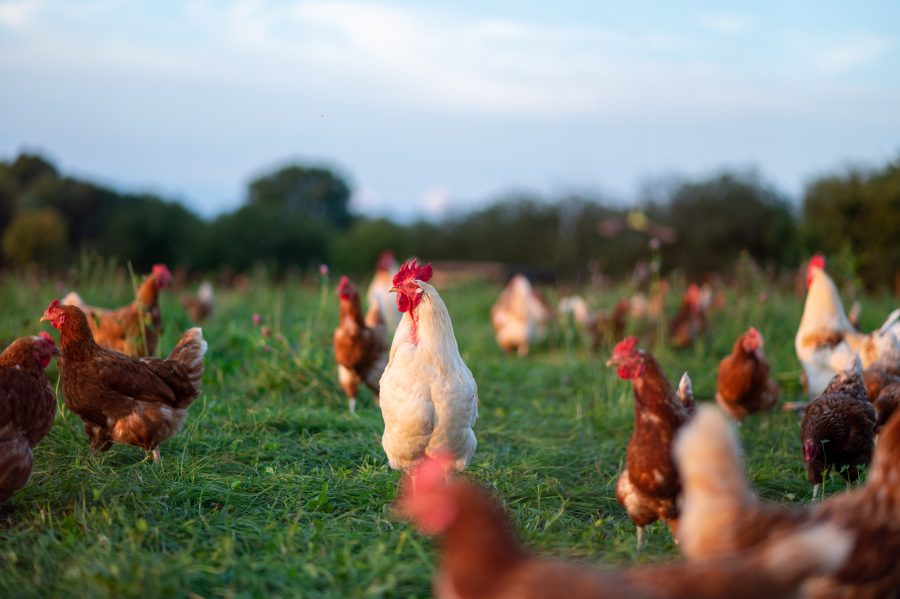
A flock of chickens roam freely in a lush green paddock near Clarkefield in Victoria, Australia
In conclusion, natural pigments are a chance to enhance health and quality poultry products and achieve customers’ preferences in an increasing market geared towards natural feed additives.
References:
– Nabi F., et al. Health benefits of carotenoids and potential application in poultry industry: A review (2020). College of Animal Science, Southwest University (China). J Anim Physiol Anim Nutr; 104:1809–1818. Available on: https://doi.org/10.1111/jpn.13375
– Langi P., Kiokias S., Varzakas T., Proestos C. Carotenoids: From Plants to Food and Feed Industries (2018). In: Barreiro C., Barredo JL. (eds) Microbial Carotenoids (NewYork). Methods Mol Biol; 1852: 57-71. Available on: https://doi.org/10.1007/978-1-4939-8742-9_3
Published by: Disproquima
Our Ingredients,